|
English National Opera's The Damnation of Faust, directed
by Terry Gilliam, had its first night on Friday 6 May 2011.
Below are a selection of reviews from the press - reviews were mixed,
but were positive overall. All photographs are by Tristram Kenton
for ENO.
Click on the images for larger versions.
The Damnation of Faust - review
The
Guardian, May 7 2011
At first sight it seems really perverse to invite Terry Gilliam
to cut his teeth as an opera director on a work that isn't really
an opera at all.
Berlioz labelled it a "dramatic legend" and intended
it for the concert hall; the pacing of the score, with its extended
orchestral interludes and ballads, and character pieces for
many of the solo vocal numbers, hardly suggests a living, breathing
piece of theatre.
But the hazy dramatic boundaries, and the latitude for interpretation
that Berlioz's recasting of the Faust legend allows, gives a
maverick creativity like Gilliam's the freedom to flourish.
Working together with a creative team of huge experience, he
has refracted the story through 100 years of German history
and culture, from the 19th century to the Third Reich, from
the romantic imagery of Caspar David Friedrich, through the
grotesqueries of Otto Dix and George Grosz to Leni Reifenstahl's
film of the 1936 Olympics.
Sometimes too much is packed into each scene - if one imaginative
stroke doesn't quite hit the mark, another is likely to comes
very soon after. But the best of what Gilliam comes up with
is by turns breathtakingly imaginative and horrifyingly vivid,
whether it's the Hungarian March serving as a backdrop to the
outbreak of world war one, Faust's seduction of Marguerite while
Kristallnacht is taking place outside her window, Marguerite's
final scene awaiting the train that will take her to a concentration
camp, or Faust and Mephistopheles's ride to the abyss in motorbike
and sidecar.
No punches are pulled, the use of video is perfectly judged,
and everything on stage has a musical as well as visual purpose.
Gilliam's direction of the singers, whether en masse or individually,
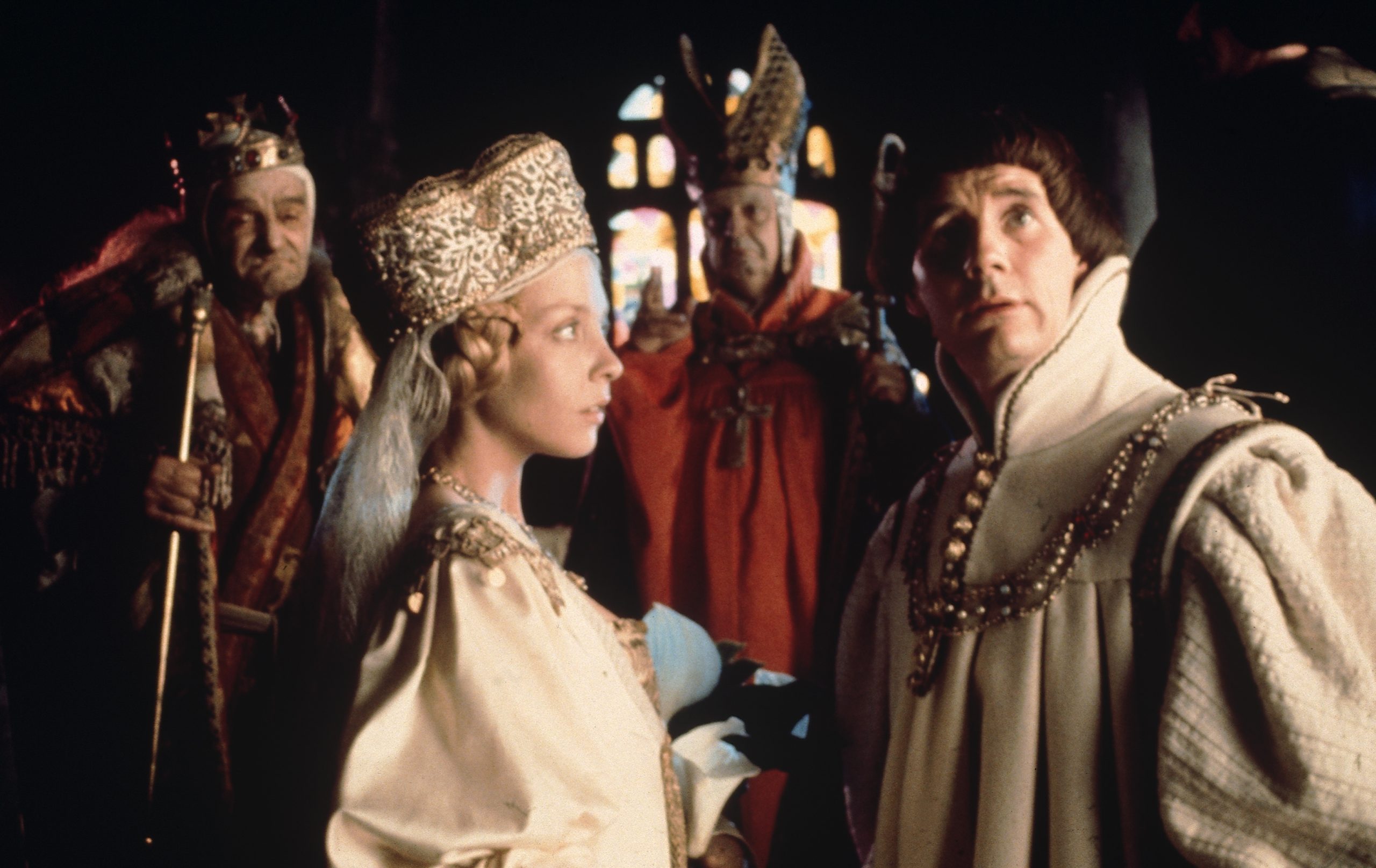
is detailed and precise too. Christopher Purves, right, as Mephistopheles
is the master of ceremonies, by turns suave, demonic or caricature,
and commandingly incisve in everything he sings. Peter Hoare
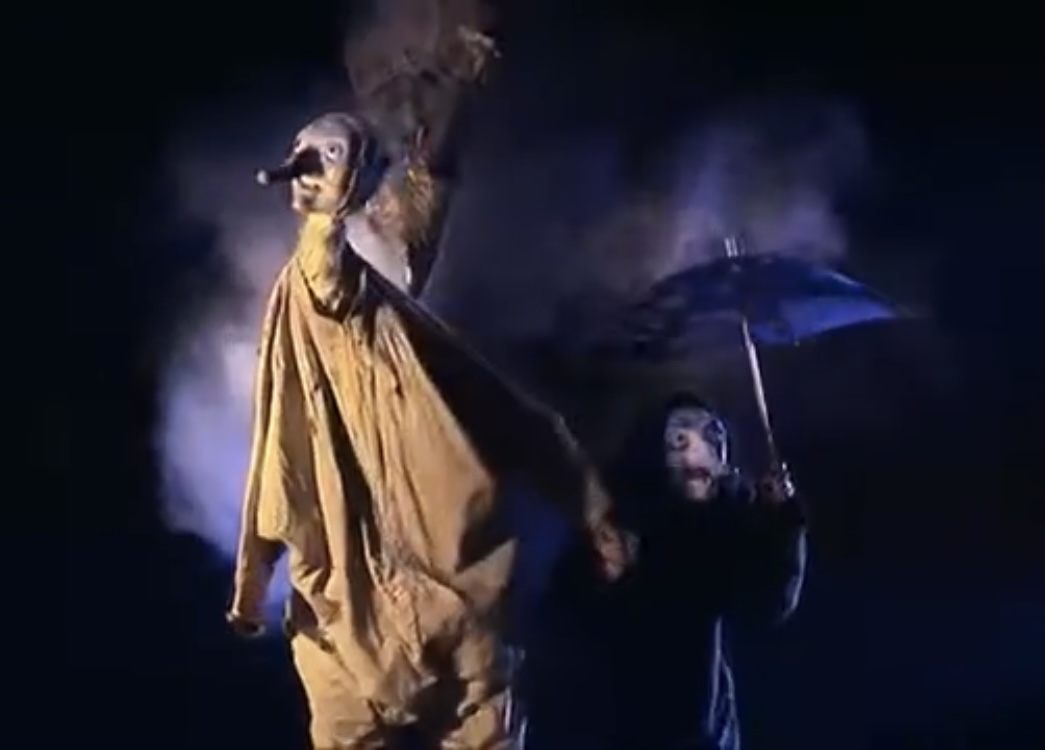
as Faust, far right, is a bizarre hybrid between Shockheaded
Peter, Friedrich Nietzsche, and a mad scientist; he sings his
numbers with great style and sense of line; Christine Rice as
Marguerite has two solos, the Ballad of the King of Thule and
the Romance, and the still points of beauty. Only the chorus
lack of presence disappoints, along with Edward Gardner's undemonic
treatment of some orchestral passages. |
The Damnation of Faust
The
Observer, May 15 2011
Based on column inches and lurid images alone, never mind the
incalculable online torrent, the big event this week was Berlioz's
The Damnation of Faust at English National Opera. After squawks
over the company's recent choice of directors from outside opera,
it was a pleasure to witness a superbly staged, ingenious production
from opera novice Terry Gilliam, best known as a Hollywood director
and genius ex-Python animator. If you want to use film in opera,
and most now do, Gilliam shows you how.
Musical standards, with Edward Gardner in the pit, were secure
though not vintage, and Berlioz's infinitely delicate score
survived just about intact despite being zipped into an all-in-one
concept and tumbling out wittily for a choreographic Treaty
of Versailles and a dance of the gas masks. The iconography
- the 1936 Olympics, Kristallnacht, a glimpse of the Obersalzberg
- pinned us firmly at the centre of a wildly spinning wheel
of modern German history, with Nazism at the hub.
Berlioz was French, and his view of Goethe, whose magisterial
verse drama is his source, is decidedly Gallic but never mind.
Unfortunately we owe it to Berlioz to mind. In Gilliam's hands
the work becomes brilliant, zany and entertaining, as this opera-cum-oratorio
rarely is in the theatre. This approach ultimately perverts
the work itself. It does not, and cannot, support the music.
Gilliam's two mantras, expressed with his irresistible and big-hearted
glee in various interviews, are "make it a good show"
and "when in doubt, use irony".
The second of these credos is where the problem lies. It's hard
to think of a work less ironic than Damnation, or Goethe's original
transcendent treatment of the Faust myth. Yes, both have sharp
humour, especially in the figure of Mephistopheles, played here
by Christopher Purves with wonderfully oily fluency and panache.
But if you pile irony on to a romantic text it cumulatively
destroys what words and music strive to illuminate.
Love, and a passionate quest for answers to life's most searching
questions, lose sincerity when pushed on to the easier terrain
of satire. Berlioz gives us several melting moments, yet their
impact is undermined. For Marguerite to address the tender ballad
of the king of Thule to a billboard poster of a smiling Aryan
soldier who looks like a golden-haired Tony Blair is almost
feasible. But to make her Jewish and deport her to a death camp
is to turn the plot into a servant of the director's staging.
This opera is not robust enough to withstand such treatment.
Nazis are currently, for better or worse, the height of directorial
fashion on the European, and specifically German, stage. You
can hardly move for Leni Riefenstahl film clips or views from
the Berchtesgaden. A recent Parsifal, and a Rienzi, have tackled
the German nation's own troubled sense of its recent history
to shocking effect. Wagner can, and probably should, be beaten
into conceptual submission. This is not to admonish Gilliam.
Few in the audience will have seen these productions. But it
may explain my own sense of a fatal mismatch. Gilliam needs
a proper opera on which to lavish his virtuosity. Rossini, for
a start, would suit him to perfection, and not necessarily a
comedy. How about the neglected tragedy Maometto II?
As Faust, Peter Hoare, a Malcolm McLaren lookalike, overstretched
himself a little in the first half but will pace himself as
the run continues, with Christine Rice a sympathetic and vocally
impressive Marguerite. Hildegard Bechtler's designs, lit by
Peter Mumford and spanning Caspar David Friedrich to art deco,
were faultless. |
Terry Gilliam's first opera is a damned fine glimpse of
the abyss
Daily
Telegraph, May 9 2011
Terry Gilliam was offering hostages to fortune in the interview
he gave this newspaper last month: the former Monty Python member
and wizard behind the bizarre movie extravaganzas Brazil, Time
Bandits and The Imaginarium of Doctor Parnassus was rehearsing
his first opera production, and the challenge had thrown him
into a cold sweat.
ENO has commissioned him to direct a piece never intended for
the opera house - Berlioz's The Damnation of Faust is emphatically
an oratorio, in which the mind's eye is required to paint its
own visions of infinite landscapes, epic battles, and the abyss
of hell.
One can see why the management thought that such a scenario
might suit Gilliam, whose style falls squarely into the "phantasmagorical
acid trip" category, but the interview suggested that he
was floundering out of his depth and complaining that he had
been driven so angry with the score that he had "started
hitting it". The omens were not good.
So what a happy surprise to discover that Gilliam was whistling
against the wind, and that the chemistry of combining his zany
visual imagination with Berlioz's sublimely individual musical
genius has sparked pure theatrical magic. Taking his cue from
Thomas Mann's novel Doctor Faustus, Gilliam interprets Berlioz's
version of the legend as an allegory of Germany's spiritual
decline, from the heights of high romantic nature-worship (a
mountain-top tableau reminiscent of Caspar David Friedrich)
through militaristic nationalism (the Radetzsky march) and the
First World War (Auerbach's cellar) to the Nazi catastrophe,
in which Marguerite becomes a young Berliner Jew , whom Faust
eventually attempts to rescue from a concentration camp.
It might sound corny, clichéd and cheap, but such is
the dramatic flair, filmic fluency and sheer inventiveness of
Gilliam and his brilliant designer Hildegard Bechtler that the
dream-like historical cavalcade, led by Faust as a sort of coxcombed
Doctor Who figure, becomes not only coherent and convincing,
but also often dazzlingly beautiful and sometimes nightmarishly
horrific. |
Gilliam's Faustian Pact
Wall
Street Journal, May 13 2011
With varying degrees of success, the English National Opera
has been engaging film directors, starting with the late Anthony
Minghella, through Penny Woolcock, Des McAnuff and Mike Figgis.
But now, triumphantly, Terry Gilliam, the sole American member
of Monty Python's Flying Circus, has been entrusted with Hector
Berlioz's "The Damnation of Faust."
Berlioz, perversely, never intended the piece to be staged.
He called it a "concert opera" (or "dramatic
legend") and since its premiere in 1846, it has rarely
had a production that won either critical or popular laurels.
A succession of familiar tunes, from the "Hungarian March"
through the "Song of the Flea," the ballad of "the
King of Thule" to Marguerite's aria "D'amour L'ardente
flame" and Faust's final "Nature immense, impénétrable
et fière," the work is held together by seven or
eight minutes of even more familiar plot. Mephistopheles seduces
Faust; Faust seduces Marguerite; she is damned for her sin;
Faust sells his soul to the devil; everybody is redeemed, sort
of.
Not much drama there, but enough space and oxygen for Mr. Gilliam's
fiery imagination to blaze. He proves he's not afraid of the
obvious by treating Goethe's Faust story as a thematic and visual
parable of German culture and society in the first half of the
20th century. Designer Hildegard Bechtler's opening set quotes
an 1818 painting of Caspar David Friedrich; and the vigorous
tenor, Peter Hoare, costumed by Katrina Lindsay in Faust's frock
coat but with a shock of red hair, recreates the solitary figure
from the German Romantic artist's painting, "The Wayfarer
Above a Sea of Fog."
We proceed, with wonderful lighting effects by Peter Mumford
and superb video work by Finn Ross, via the imagery of Otto
Dix and George Grosz, to a Python-esque view of World War I
as an attempt to divide up the world as a cake, using the swords
of the crowned heads of Europe, and then another Python touch
of a cavalry charge on hobby horses. Mephistopheles (the suave
Christopher Purves) reveals Faust's dreams by letting him, Walter-Mitty-like,
assist in battlefield surgery.
At a Bierkeller during the Weimar Republic, Brander's (Nicholas
Folwell) song is anti-Bolshevik, and we suddenly see that everyone
present is a Nazi Brown Shirt. The cabaret number, the "Song
of the Flea," is anti-Semitic, Jews are beaten up, and
Faust is revolted. Next he is at a cocktail party for the German
High Command, catches sight of Marguerite (magnificently sung
and acted by Christine Rice) and witnesses a hilarious Wagner-pastiche
entertainment.
Leni Riefenstahl's massed athletes celebrate the 1936 Olympic
games and Kristallnacht is all the fault of demonic sprites,
who round up hordes of Jews. Marguerite turns out to be Jewish
herself, kinkily fantasizing about the blond Nazi on the poster
she sees from her bedroom window. She's sent to a death camp.
Faust burns his books. The final tableau is chilling.
As an ex-Python Mr. Gilliam surprises us by finding little
humor in the jackboots and goose-stepping. His Faust is funny
in places; but what impresses is his consistent, full embrace
of the horrific tragedy of the failure of German culture.
His success must be measured, too, not just in how profoundly
and disturbingly he's marshaled the familiar imagery and vast
cast, but how carefully he's listened to the music, and treated
conductor Edward Gardner as a full partner in this dazzling
enterprise.
|
Terry Gilliams Gas-Chamber Faust Is Sick
Joke
Bloomberg,
10 May 2011
Terry Gilliam, the Monty Python cartoonist and Hollywood film
maker, serves up impressive spectacle and insalubrious taste
in his Holocaust-based The Damnation of Faust at
English National Opera in London.
The opera novice turns Berliozs 1846 opera-oratorio
into a gallows-humor show about the rise of National Socialism.
Faust (Peter Hoare, made to look like the odd anti-hero of
David Lynchs film Eraserhead) is a dreamy
German thinker. He first appears against the kind of sublime
romantic landscape made famous by painter Caspar David Friedrich.
Hildegard Bechtler creates stylized sets with plenty of wow
factor.
Then along comes jolly Mephistopheles (Christopher Purves),
who lures Faust into the bombastic grandeur of Nazism. He
even conjures up a razzle-dazzle choreographed recreation
of the 1936 Berlin Olympics to tempt him.
The members of the somewhat portly male chorus, in white
shorts and stomach-squeezing corsets, do their best to look
like Aryan gods.
Faust falls in love with a young Jewish girl, Marguerite
(Christine Rice), and then abandons her. Marguerite is herded
off to Auschwitz by the Nazis.
When Mephistopheles offers Faust the chance to rescue her, it
leads to the highlight of an evening already bursting with surprising
theatrical flair. They jump in a motorbike and sidecar, and
take a thrilling night ride among dazzling, whirling video projections.
At the orchestral climax, Faust learns that he has been duped.
Hes flung into the gas chamber himself. There are exciting
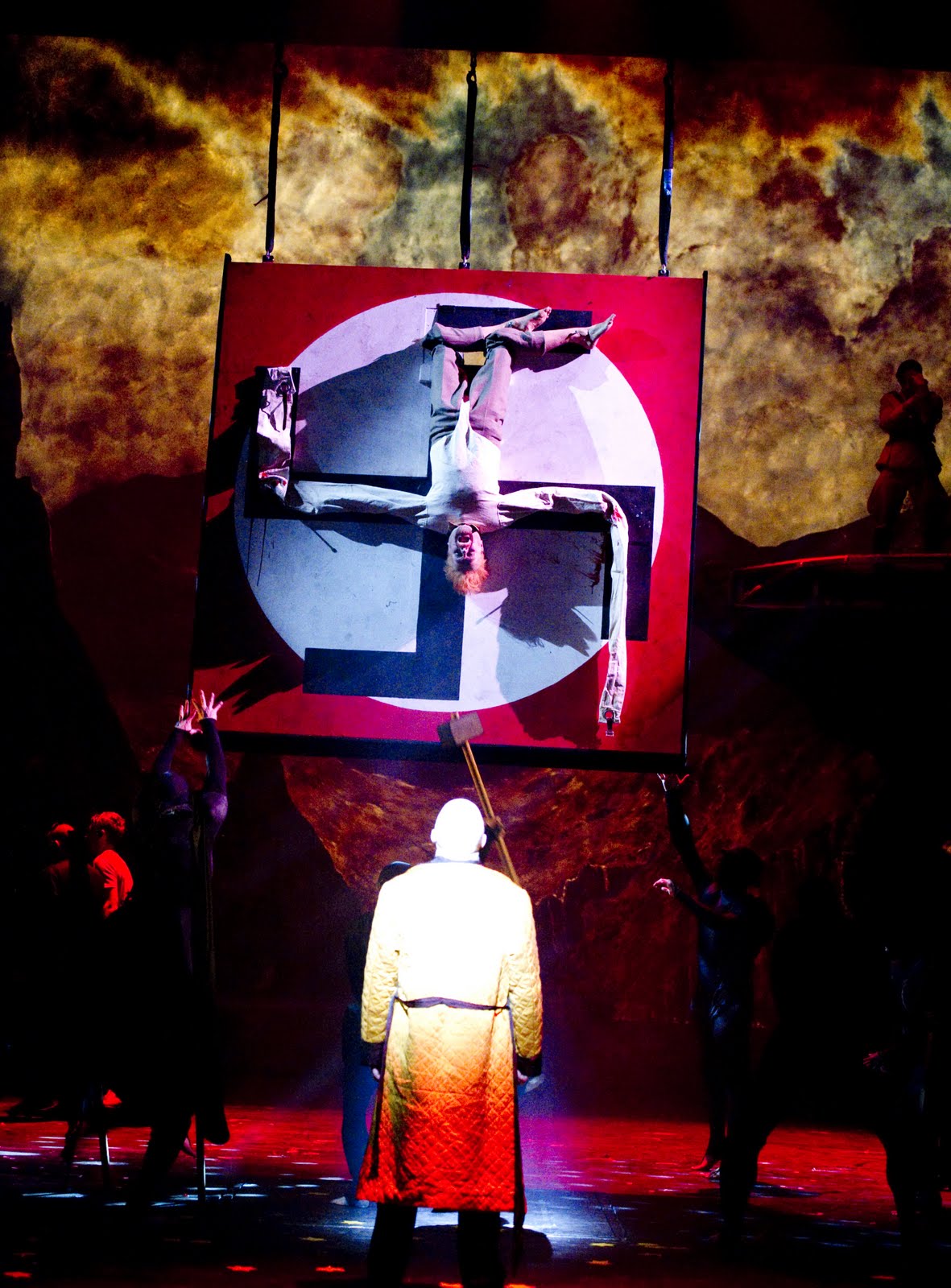
explosions and real flames. He rises from the fire transformed
into a surreal human swastika. Flakes of charred flesh then
gently flutter over Marguerites body, while a celestial
choir hymns her soul.
It looks expensive, and feels cheap as hell.
Should the Holocaust be trivialized this way for the sake
of a coup de theatre? Is a jokey, cool, ironic tone really
appropriate for the subject? Gilliam offers no new insights
into anti-Semitism or the rise of German militarism.
Kristallnacht as a lively production number. Dancing Nazis.
It comes perilously close to a non-parody version of Mel Brookss
fiction play Springtime for Hitler, without the
rigorous framing device of The Producers to make
such a risk of taste acceptable.
Musically, standards are high. Conductor Edward Gardner delights
in Berliozs exquisite orchestration. Hoare sings with
a good ringing timbre, even if his voice tires by the end.
Rice brings vocal splendor and touching pathos to Marguerite.
Purves, as the uber-Nazi Mephistopheles, offers us a silken
baritone, conspiratorial winks at the audience, and deep throaty
chuckles.
Its disturbing, but not in the way intended. |
The Damnation of Faust, Coliseum, London
The
Independent on Sunday, May 8 2011
If in doubt, stick a swastika on it.
It worked for Alan Coren's Golfing for Cats. But does it work
in The Damnation of Faust? Terry Gilliam's debut production
with English National Opera transposes Berlioz's légende
dramatique to the Third Reich: casting Mephistopheles's "Song
of the Flea" as anti-Semitic propaganda, crucifying a straitjacketed
Faust on a giant swastika, and hymning the redemption of Marguerite
as her gassed corpse rots on a pile of looted mannequins.
Faust is a first for the film director, animator and ex-Python.
Much like his films, Gilliam's staging is at once ironic, romantic
and provocative. He has done his homework, presenting a smooth,
if simplistic, reading of German cultural history from Caspar
David Friedrich to Berchtesgaden, Valhalla to Belsen. Stagecraft
and video projection combine with more impact than in Mike Figgis's
Lucrezia Borgia. The Marche Hongroise is an antic pantomime
of Prussian, Russian, Austrian, English and French Empires in
conflict (design by Hildegard Bechtler). Act II closes with
footage from Leni Riefenstahl's Olympia, while the Menuet des
Follets is a Kristallnacht ballet. These are the big set pieces.
But the production sags in the dream-like vapours of what happens
between them.
Conductor Edward Gardner has chosen a particular orchestral
sound as default and seldom varies its intensity. Excepting
the langorous cor anglais solo, what registers is an amorphous
pastel wash. Vocally, the choruses lack vitality, and menace
is notably absent from the Pandemonium. Though Christine Rice
brings voluptuous gravity to Marguerite's arias, she looks uncomfortable
with Gilliam's characterisation of Goethe's heroine as a Jewish
woman with a sexual craving for brown-shirts. Shock-wigged and
clarion-clear in Acts I and II, Peter Hoare's Faust falters
in Acts III and IV. Kinetic energy and musical intelligence
are great assets, but the role requires an easy-access high
register. As pimp, magician, Kommandant, comedian and MC, Christopher
Purves is a seductive Mephistopheles. There's much to admire
and even more to object to in Gilliam's operatic debut. But
added up, all you have is Goethe for Cats, with extra swastikas. |
Also at Dreams:
Terry Gilliam talks to Dreams about
The Damnation of Faust
|